Wickedly Sharp
Hand Sharpened Knives and Tools
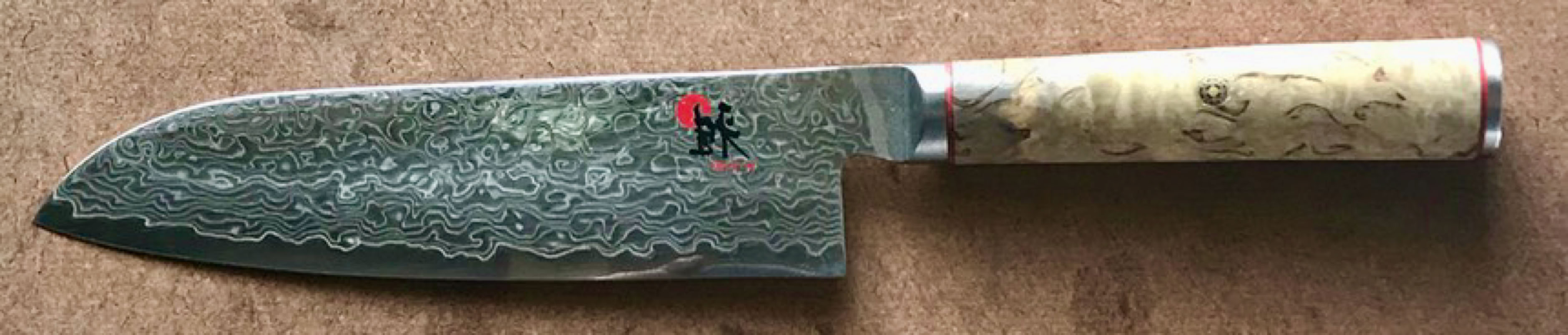
Knife Anatomy
Like all tools there are different names for different parts of the knife.
Knife Anatomy
Some terms used to describe parts of a knife and the knife edge.
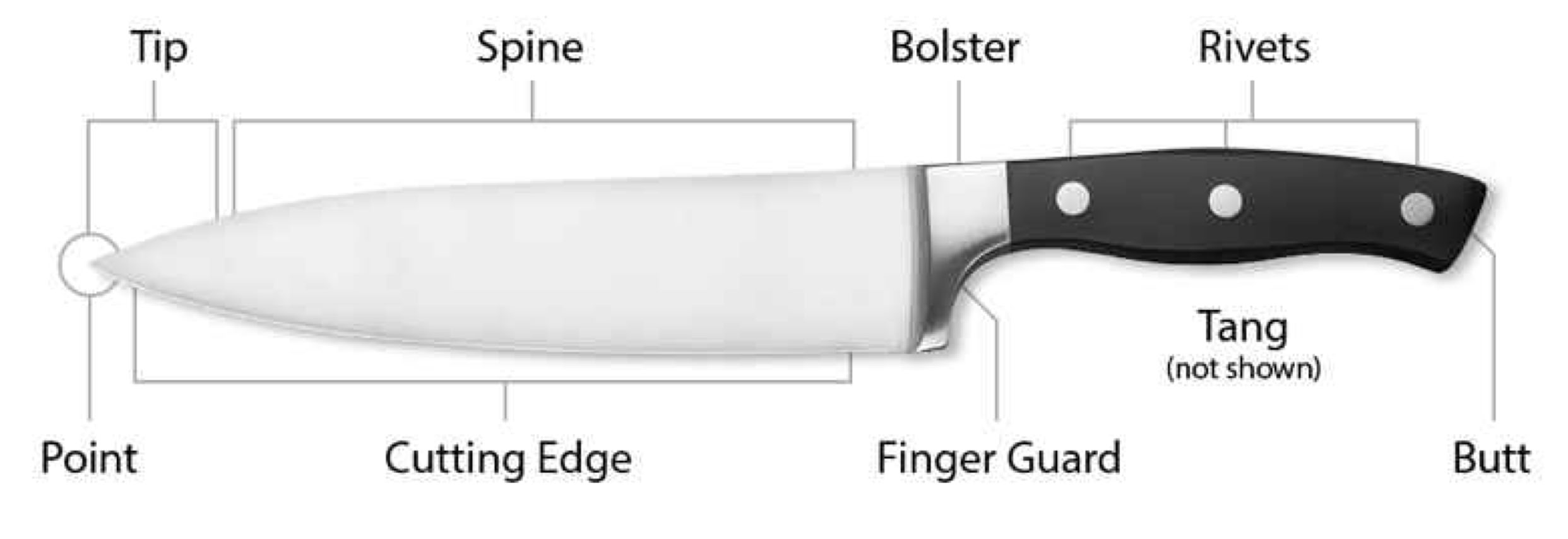
Knife Terms
Point- is the furthest part of the knife from the handle. It is the part of the knife that would the first to make contact with an item that is stabbed or pierced.
Tip- is the first third of the knife and includes the point. This part has a belly or curve that the knife is rocked on when cutting herbs.
Heel- is the cutting edge at the opposite end of the blade to the tip. It is the closest third of the knife used to cut.
Shoulder - is the line that forms the boundary between the bevel and the face of the knife.
Face / Blade- is the side of the knife between the shoulder and the spine.
Spine- is opposite the cutting edge. The spine gives the blade strength
Bolster- is the transition between the blade and the handle. Usually includes the finger guard
Finger Guard - the lower part of the bolster that protects the fingers from sliding down the edge
Tang- is the part of the blade that extends into the handle. A tang that extends all the way to the butt of the handle is known as a full tang.
Scales - the parts of the handle that have been glued and riveted to the tang.
Butt- is an end cap of metal proving balance and beauty to the knife.
Knife Edge Terms
Cutting Edge / Edge / Primary Edge- is the sharpened edge of the blade and it runs from heel to tip.
Secondary Edge- some knives may have two edges on the one Face. A Primary Edge and a Secondary Edge. This is usually seen in knives with a narrow bevel (e.g. 18 degrees). The secondary edge is usually a much wider angle (e.g. 20 degrees) to give the edge more strength and durability. The primary edge is usually created first.
Bevel- is the width of the cutting edge (edge to shoulder). Where there are two edges (primary and secondary) there is a primary and secondary bevel.
Double Bevel- is when the knife is sharpened on both sides.
Shoulder - is a line running parallel to the edge. It represents the boundary between the edge and the face of the knife. A secondary shoulder may be present when there is a secondary bevel